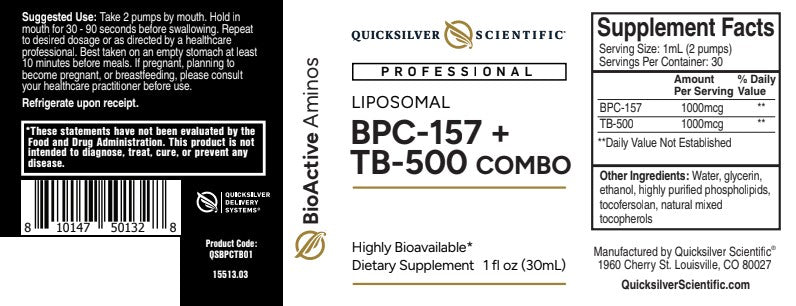


What it is: Liposomal BPC-157 + TB-500 is a professional-grade, dual-action oral regenerative peptide formula developed by Quicksilver Scientific, delivering BPC-157 (Body Protection Compound 157) and TB-500 — a synthetic active fragment of the naturally occurring protein Thymosin Beta-4 (Tβ4) — in Quicksilver Scientific's proprietary Quicksilver Delivery Systems® (QDS®) liposomal format. This advanced liposomal technology produces phospholipid vesicles of 20–100 nanometers — small and stable enough to pass between cells and be absorbed directly through mucosal membranes during sublingual hold — providing dramatically enhanced bioavailability and rapid systemic peptide delivery compared to conventional unformulated oral peptide preparations. The BPC-157 + TB-500 combination is specifically formulated for clients requiring a more advanced and accelerated approach to tissue repair and recovery — combining BPC-157's localized tissue healing, angiogenic, and gastroprotective activity with TB-500's broader systemic healing, cellular migration, and immune-modulatory properties into a single, non-invasive, twice-daily oral protocol. Designed exclusively for professional practitioner-directed use in advanced tissue repair, sports recovery, post-operative healing, musculoskeletal, vascular, and neurological support protocols.
How it works: Liposomal BPC-157 + TB-500 supports broad-spectrum tissue healing and regeneration through the complementary and synergistic mechanisms of its two constituent peptides, which address both site-specific repair and systemic regenerative signaling simultaneously. BPC-157 (Body Protection Compound 157) is a 15-amino acid synthetic peptide derived from the BPC protein naturally present in human gastric juice, functioning primarily through upregulation of the nitric oxide (NO) signaling system and VEGF (vascular endothelial growth factor)-mediated angiogenesis — promoting the formation of new blood vessels essential for delivering oxygen, nutrients, and growth factors to damaged tissue. BPC-157 upregulates growth hormone receptor (GHR) expression in tendon fibroblasts, enhancing the anabolic cellular response to circulating growth hormone and accelerating tendon, ligament, and muscle fiber repair. Its gastroprotective mechanism involves direct cytoprotective activity on gastrointestinal epithelial cells — stabilizing tight junction proteins, counteracting NSAID- and alcohol-induced mucosal damage, and supporting gut-brain axis signaling through serotonergic and dopaminergic pathway modulation. Emerging research highlights BPC-157's neuroprotective potential through its support of hippocampal gene expression and cerebrovascular circulation following neurological insult. TB-500 is a synthetic 17-amino acid peptide corresponding to the active actin-binding region of Thymosin Beta-4 (Tβ4) — a 43-amino acid peptide encoded by the TMSB4X gene and present in virtually all human tissues. TB-500's primary mechanism involves sequestration and regulation of G-actin — promoting cellular migration, proliferation, and differentiation of multiple cell types involved in tissue repair including endothelial cells, keratinocytes, and muscle satellite cells. TB-500 independently upregulates VEGF and related pro-angiogenic growth factors to support new blood vessel formation critical to tissue repair, suppresses pro-inflammatory cytokines (TNF-α, IL-1β) while increasing anti-inflammatory IL-10, and supports muscle fiber repair and growth through satellite cell activation. The combination of BPC-157's site-specific angiogenic and cytoprotective repair activity with TB-500's broader systemic cellular migration and immune-modulatory regenerative signaling provides a synergistic tissue healing mechanism operating across both local and systemic tissue repair dimensions simultaneously.
When to use it: Liposomal BPC-157 + TB-500 is appropriate for exclusive practitioner-directed use in adult clients requiring advanced, accelerated tissue repair and recovery support — particularly those recovering from acute injury, surgical procedures, or physical overexertion where conventional recovery timelines are clinically insufficient. It is well-suited for protocols targeting tendon, ligament, muscle, joint, and connective tissue repair; vascular integrity support; gastrointestinal mucosal repair; and neurological tissue recovery. This formula is specifically distinguished from the BPC-157 + KPV combination by its emphasis on musculoskeletal and vascular tissue repair over gut and antimicrobial applications — making it the preferred peptide combination for athletic performance recovery, post-operative healing, and musculoskeletal injury protocols. Two pumps (1 mL) held sublingually for 30–90 seconds before swallowing, taken on an empty stomach or at least 10 minutes before meals, provides the full dual-peptide serving with optimal mucosal absorption. This product requires refrigeration upon receipt to preserve peptide integrity.
Serving Size: 2 Pumps (1 mL)
Servings Per Container: 30
Suggested Use: Take 2 pumps by mouth. Hold in mouth for 30–90 seconds before swallowing. Repeat to desired dosage or as directed by your healthcare practitioner. Best taken on an empty stomach or at least 10 minutes before meals.
|
Ingredient |
Amount Per Serving |
% Daily Value |
|
BPC-157 (Body Protection Compound 157) |
1,000 mcg |
† |
|
TB-500 (Thymosin Beta-4 Active Fragment) |
500 mcg |
† |
† Daily Value not established.
Other Ingredients: Water, glycerin, ethanol, highly purified phospholipids, tocofersolan, natural mixed tocopherols.
Free of: Gluten, soy, dairy, GMOs, artificial flavors, and synthetic preservatives.
Caution: For professional use only. If pregnant or nursing, consult your healthcare practitioner before use. Keep out of reach of children. Do not use if tamper-evident seal is broken or missing. Refrigerate upon receipt to preserve peptide integrity.
✓ Gluten Free ✓ Dairy Free ✓ Soy Free ✓ Non-GMO ✓ No Artificial Flavors or Synthetic Preservatives
Key Ingredients
BPC-157 (Body Protection Compound 157) — 1,000 mcg BPC-157 is a 15-amino acid synthetic pentadecapeptide derived from the BPC protein naturally secreted in human gastric juice, functioning as one of the most versatile and broadly researched regenerative peptides across gastrointestinal, musculoskeletal, vascular, and neurological tissue repair applications. Its primary angiogenic mechanism involves upregulation of VEGF expression and nitric oxide synthase activity, promoting the formation of new capillary networks that deliver the oxygen, nutrients, and growth factors necessary for sustained tissue repair — with demonstrated healing acceleration in transected tendons, ligaments, and muscle fibers across multiple animal models without formation of scar tissue. BPC-157 additionally upregulates growth hormone receptor (GHR) expression in tendon fibroblasts, enhancing local tissue sensitivity to circulating growth hormone and amplifying the anabolic repair response in connective tissue. Gastrointestinal cytoprotective activity involves direct stabilization of intestinal epithelial tight junctions, counteraction of mucosal damage from NSAIDs, alcohol, and inflammatory mediators, and modulation of the gut-brain axis through serotonergic and dopaminergic pathway influence — establishing BPC-157 as a uniquely multi-system regenerative peptide with clinical relevance spanning acute injury recovery, gut mucosal repair, and neurological resilience support simultaneously.
TB-500 (Thymosin Beta-4 Active Fragment) — 500 mcg TB-500 is a synthetic 17-amino acid peptide corresponding to the actin-binding domain (residues 17–23) of Thymosin Beta-4 (Tβ4) — a 43-amino acid intracellular peptide encoded by the TMSB4X gene and present in virtually all human tissues except erythrocytes — providing the primary bioactive sequence responsible for Tβ4's well-characterized regenerative activity in a more pharmacologically viable and orally deliverable fragment. TB-500's primary mechanism involves G-actin sequestration and regulation — binding free actin monomers to promote cytoskeletal reorganization that drives cell migration and proliferation of endothelial cells, keratinocytes, muscle satellite cells, and immune cells into sites of tissue damage, providing the cellular trafficking infrastructure necessary for organized tissue repair. TB-500 independently stimulates VEGF and related pro-angiogenic growth factor upregulation to support neovascularization of healing tissue, suppresses pro-inflammatory cytokines TNF-α and IL-1β while increasing anti-inflammatory IL-10 to support an appropriately regulated immune healing environment, and activates muscle satellite cells to support skeletal muscle fiber repair and growth following injury or mechanical overload. The complementarity of TB-500's systemic cellular migration and broad angiogenic activity with BPC-157's localized angiogenic, cytoprotective, and receptor-sensitizing mechanisms creates a synergistic dual-peptide tissue repair system that addresses both the cellular trafficking and the local growth factor signaling dimensions of comprehensive musculoskeletal and connective tissue healing.